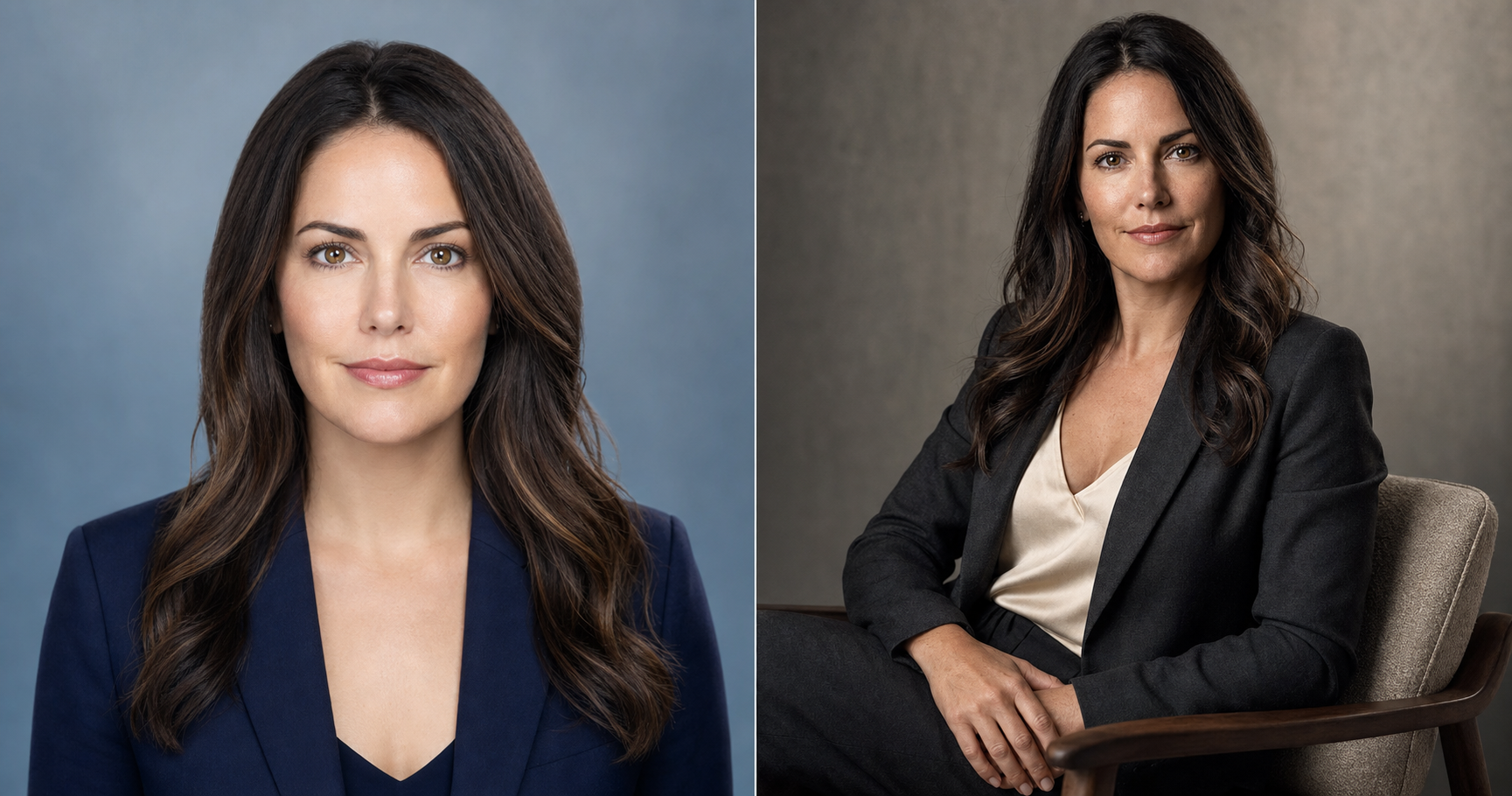
She paid $79 for the AI-headshot service on Saturday. Sunday morning she pasted the best of the eighty renders into her About page, hit save, and sat back. By Sunday night the prospect she’d been chasing for three weeks replied: “Got your note, going a different direction.” The portrait wasn’t ugly. It just looked like someone else in a wax museum. Recruiters and buyers can clock that face in about half a second.
The Wax-Figure Tell
Most AI-headshot advice tells you to pick the right tool. That’s the wrong question.
The tool isn’t the problem. The default prompt is. Every AI-headshot service on the market runs the same kind of generic prompt under the hood, one that asks the model for “a professional headshot of this person,” and then lets the model fill in the rest from the most boring center of its training data. The result is what I call The Wax-Figure Tell: porcelain skin with the pores erased, eyes that are pointing at the camera but not looking out of it, cheekbones a hair too symmetric, hair too perfectly placed. Almost you. Not you.
A real buyer doesn’t sit there listing the tells. They feel them. The lizard brain that scans a face in a glance and decides whether to trust the person on the other side of it has been calibrated on real faces since you were six months old. When it lands on a face that’s been smoothed by a stock-photo training set, it bounces. The prospect doesn’t say “this portrait looks AI-generated.” They say “going a different direction.”
That’s the deal you lost. Not because your offer was wrong. Because your face on the About page didn’t match the email you sent.
The good news: the tool didn’t fail. The default prompt did. And once you can name the five tells, you can fix all five in the same paste.
Five Reasons AI Headshots Look Fake
Five things go wrong in the default prompt. They show up together. The way the prompt below works is by killing all five at once, not one at a time.
1. Style-Mix default beauty filter
The model averages every face in its training data and serves you the average. Porcelain skin. No pores. No fine lines. No micro-asymmetry. You don’t look airbrushed; you look erased. Real skin has texture, and the prompt has to say so explicitly or the model won’t put it in.
2. Identity drift across renders
The longer the prompt runs and the more transformations stack on top of “the person in the uploaded photo,” the further the face drifts from your reference. By the time the model gets to “in the style of cinematic editorial portrait,” it has half-forgotten who the person was. Identity has to be the first thing the prompt locks, not the last. (The pillar piece on why AI images look fake walks through the identity-drift mechanism in more detail. That’s the broader version of the failure mode; this section is the founder-portrait-specific cut.)
3. Generic LinkedIn-stock lighting
The default lighting AI serves you is flat front-light at fifty millimeters. No directional key, no fall-off, no shadow on the cheekbone. It’s the lighting the model saw in ten million LinkedIn thumbnails. Real editorial portraits don’t look like that. They have a key light. They have a fill. There is a shadow on one side of the face that tells you which way the room is lit.
4. Too-perfect symmetry
Real faces are asymmetric. One eye sits a hair higher than the other. The mouth tilts. The bone structure on the left side of your face is not the bone structure on the right. The AI default smooths all of that out, which is why a “perfect” AI portrait looks like a portrait of a sibling you don’t have. The fix is to forbid the smoothing by name.
5. Mood-board wardrobe and setting
Every AI headshot generator gives you the same five-to-ten preset wardrobe / setting combinations. The blue blazer in front of the bookshelf. The sweater on the beach. The grey suit at the conference table. None of them are your room. None of them are the jacket you own. A real founder portrait reads as “this specific person in this specific room,” not “AI mood-board, generic.”
Five mechanisms. All five fixable in the same prompt, once you know what a real studio day actually buys you.
What a $1,200 Studio Day Actually Buys You
Here’s the part most people get wrong. They look at the $1,200 figure and assume they’re paying for the photographer’s talent. They’re not. They’re paying for four specific variables that show up in every editorial portrait, the kind that runs in Forbes, sits on a book cover, or anchors a pitch-deck slide.
Variable one: an 85mm lens at f/1.4. That’s the standard editorial-portrait optic. It compresses the face flatteringly, separates you from the background, and gives the shallow depth-of-field that says “this is a portrait” instead of “this is a snapshot.”
Variable two: directional cinematic key plus cool fill. A real photographer puts a soft key light at the upper-left at roughly forty-five degrees, then a gentler cool fill on the shadow side. That’s what makes the bone structure read on camera. The “flat-front-LinkedIn-stock” look fails here.
Variable three: a real chair in a real room. Not a green-screen backdrop. Not a stock photo. An actual architectural piece of furniture, an actual paper-textured backdrop, an actual atmospheric depth behind you that goes out of focus. The setting decorates; it doesn’t compete.
Variable four: a human director. This is the one a prompt can’t buy. The photographer who tells you to lower your chin a quarter inch, exhale before the shutter clicks, drop the shoulder. That’s the part you give up when you skip the studio day.
Three of the four variables are language. The prompt below copies them word for word. The fourth, the chin-tilt director, is the honest gap. You make up for it by regenerating until the face reads like you. Studio takes ten minutes between shots; the prompt takes ten seconds.
The Prompt That Does the Same Job
Upload one clear front-facing photo of yourself, paste the block below into ChatGPT (or Claude, Gemini, or any AI image tool), and swap the two placeholders for your setting and your wardrobe.
The full prompt, copy & pasteTap to expand
**Generate this image:**

A single photoreal 2:3 vertical cinematic editorial portrait of the person from the uploaded reference image. Match their bone structure, eyes, nose, lips, proportions, and skin tone exactly so the subject is clearly recognizable. The subject is seated upright with quiet authority, body angled three-quarters to camera, both hands resting naturally on the chair arms, eyes meeting camera with a calm, grounded, slightly confident expression, not smiling, not stern. They wear {ATTIRE_STYLE}. The setting is {SETTING}, with a soft directional cinematic key light from the upper-left at roughly 45° and a gentle cool fill on the shadow side, producing rich but never harsh contrast. The subject occupies 50-70% of the vertical frame, anchored slightly above center; the background remains atmospheric and out of focus but never competes with the subject. Skin shows visible pores, fine micro-texture, and natural micro-asymmetry; no porcelain smoothing. Shot on an 85mm lens at f/1.4, shallow depth of field, premium editorial photography style. Single 2:3 vertical cinematic editorial portrait, identity-locked to the uploaded reference.

**Rules the AI must follow:**
- Aspect ratio 2:3 vertical portrait: strict, locked at the start and the end of the prompt
- Identity preservation is the highest-priority constraint: match the uploaded reference photo's bone structure, eyes, nose, lips, proportions, and skin tone exactly; the subject must be unmistakably the same person
- Subject occupies 50-70% of the vertical frame: do not let the setting decoration overwhelm the person
- Realistic skin texture required: visible pores, fine micro-asymmetry, natural unevenness; no porcelain smoothing, no over-retouched beauty filter, no waxy AI-plastic surface
- One human figure only: solo subject; no advisors, no crowd, no background people, no multi-exposure ghosts
- No text, captions, watermarks, logos, brand marks, or readable signage anywhere in the frame
- Single image output: no contact sheet, no variant grid, no before/after split, no multiple angles in one frame
- All text in English Latin script if any incidental signage appears
- Output the image directly without explaining the prompt back

**Replace these placeholders with your details:**
- ⚠️ **REQUIRED. Upload before pasting**: a clear, well-lit front-facing photo of your face (this is the face the AI will keep; without it the portrait will not look like you)
- {SETTING} = a modern minimalist studio with a softly lit warm-grey paper backdrop and a single architectural chair (or pick one; see Bonus tips below for swaps)
- {ATTIRE_STYLE} = a well-tailored charcoal suit jacket over a crisp white open-collar shirt, no tie, modern minimal silhouette (or pick one; see Bonus tips below for swaps)
The prompt does four load-bearing things that map directly to the five tells.
It identity-locks to the photo you uploaded. The phrase that’s doing the work: “match their bone structure, eyes, nose, lips, proportions, and skin tone exactly so the subject is clearly recognizable.” That kills failure mode #2 (identity drift) before any other instruction in the prompt runs. The identity lock is the first rule, not the last. That positioning matters. I call this move The Identity-Lock Test: the very first sentence of any portrait prompt you ever paste should name the face. Not the style. Not the platform. The face.
It forces 50–70% frame occupancy on the subject. That kills the “AI mood-board setting overwhelms the person” tell. The setting decorates; you don’t disappear inside it.
It forbids porcelain skin by name and requires visible pores and micro-asymmetry. That kills failure mode #1 (Style-Mix beauty filter) and failure mode #4 (too-perfect symmetry) in one rule. The model has to put real skin texture back, and it has to break the smoothing default by name.
It locks “one human figure only” and bans multi-exposure ghosts. A surprising number of AI portrait prompts deliver three of you in one frame because they didn’t say not to. This one says not to.
The rest of the prompt (the 85mm at f/1.4, the directional key from upper-left, the cool fill on the shadow side, the 2:3 vertical aspect ratio) is the language version of the three studio variables we just named. Same fix, paste-ready. The full version of this prompt plus the rest of the career-portrait sub lives in the Image Prompt Pack. Or you can paste the block above and skip the pack. Both are honest paths.
Five Founders, Five Variants
Same prompt. Two placeholders swapped. Five different careers.
The solo strategy consultant
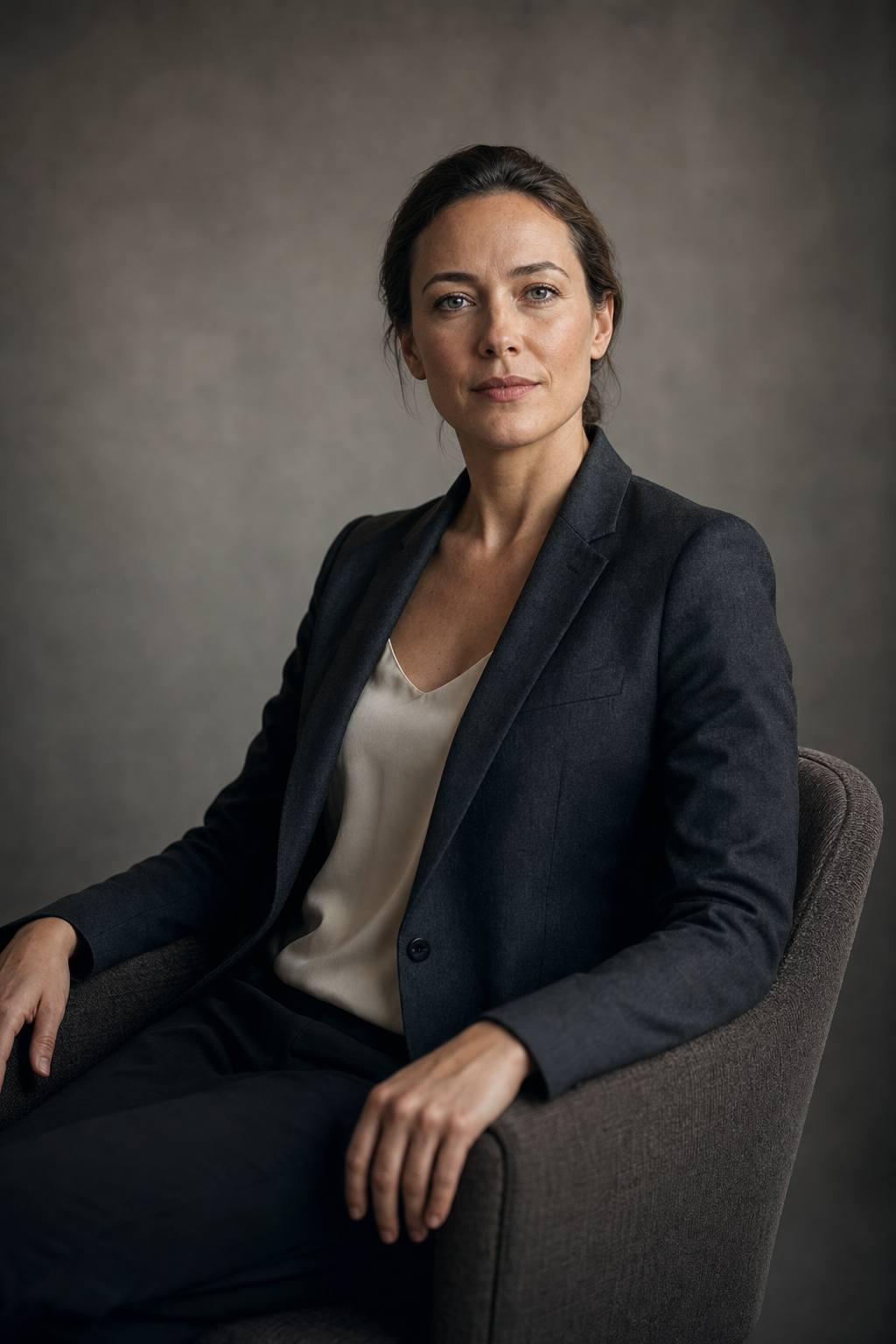
{SETTING} = a modern minimalist studio with a softly lit warm-grey paper backdrop and a single architectural chair. {ATTIRE_STYLE} = a well-tailored charcoal blazer over a cream silk shell, no tie. This is the About-page hero for a B2B consultant who charges by the day. Skin reads as skin; the warm-grey backdrop does what a real studio backdrop does, which is fade behind you.
The indie SaaS founder
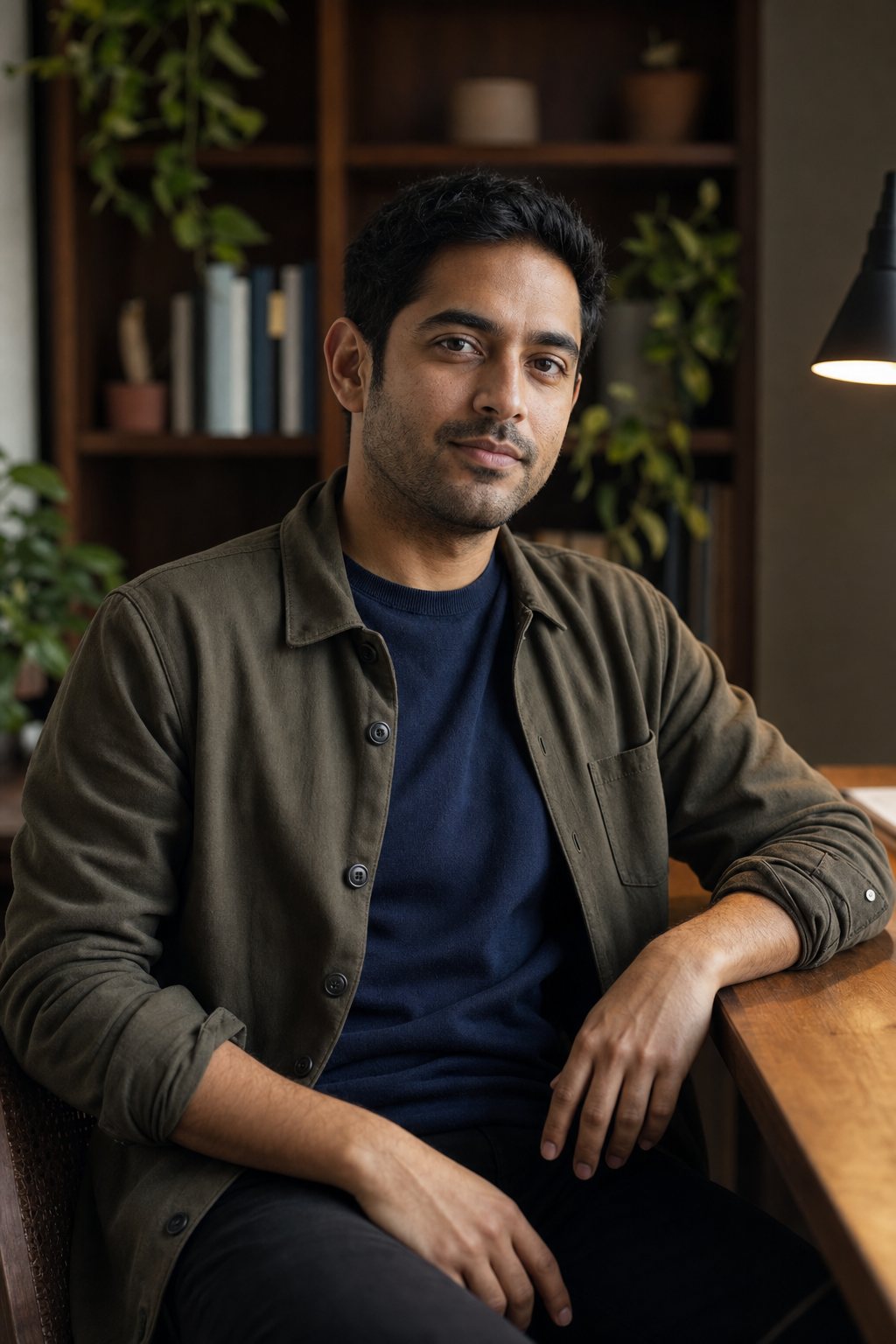
{SETTING} = a quiet home office with an out-of-focus walnut bookshelf, two plants softening the shelf, a single warm desk lamp on the right edge of frame. {ATTIRE_STYLE} = a navy crew-neck merino over an olive cotton overshirt, sleeves pushed once. This is the indie founder About page, the one that doesn’t pretend to be a corporate enterprise but doesn’t read as “I just woke up” either.
The freelance creative director
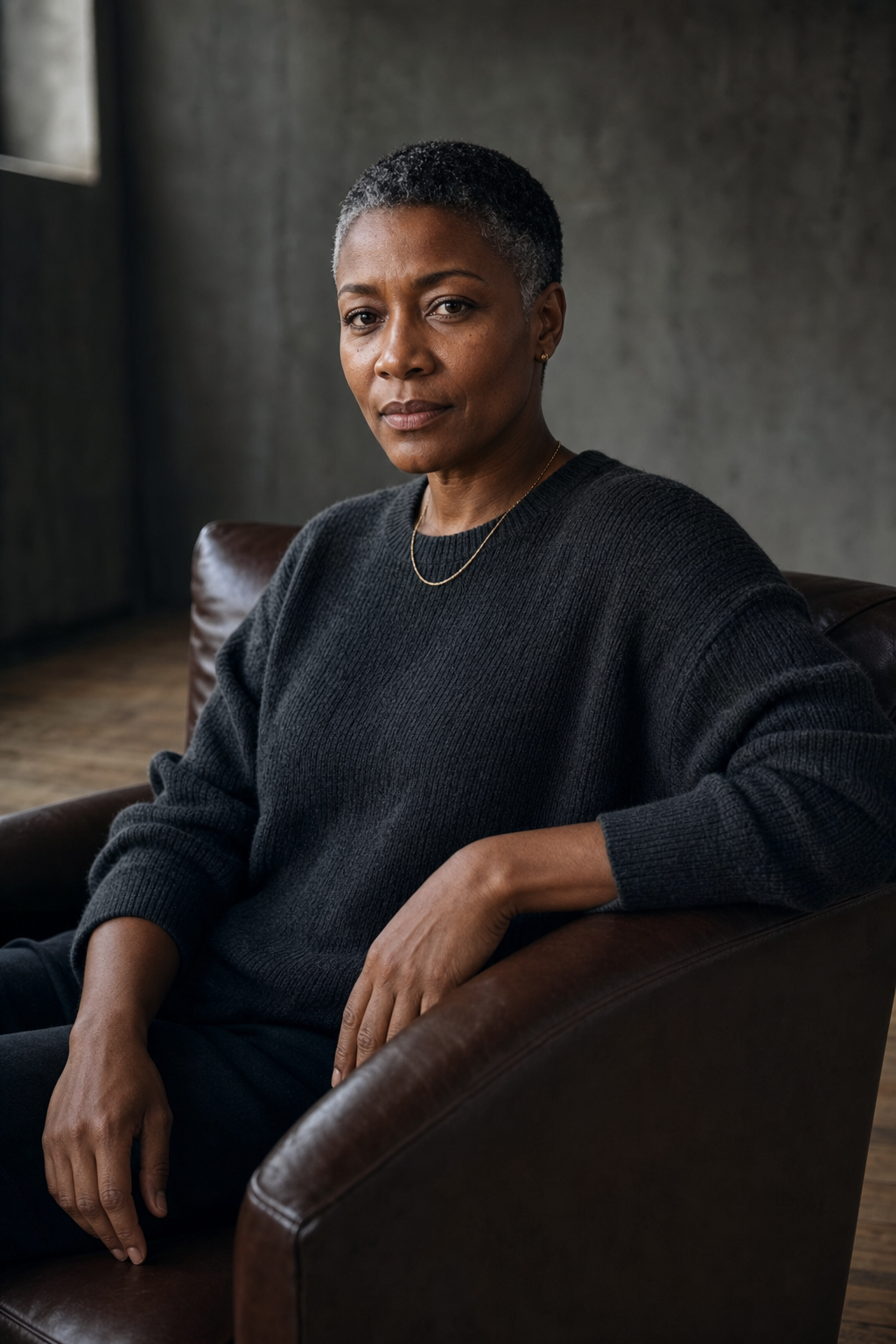
{SETTING} = a quiet studio with a dark concrete wall and an empty wooden floor, single window key from upper-left. {ATTIRE_STYLE} = a soft charcoal heavyweight knit, single thin gold chain visible. This is the editorial-magazine register. The dark concrete wall does the work the warm-grey backdrop does in version one, just in the opposite tonal direction.
The executive coach
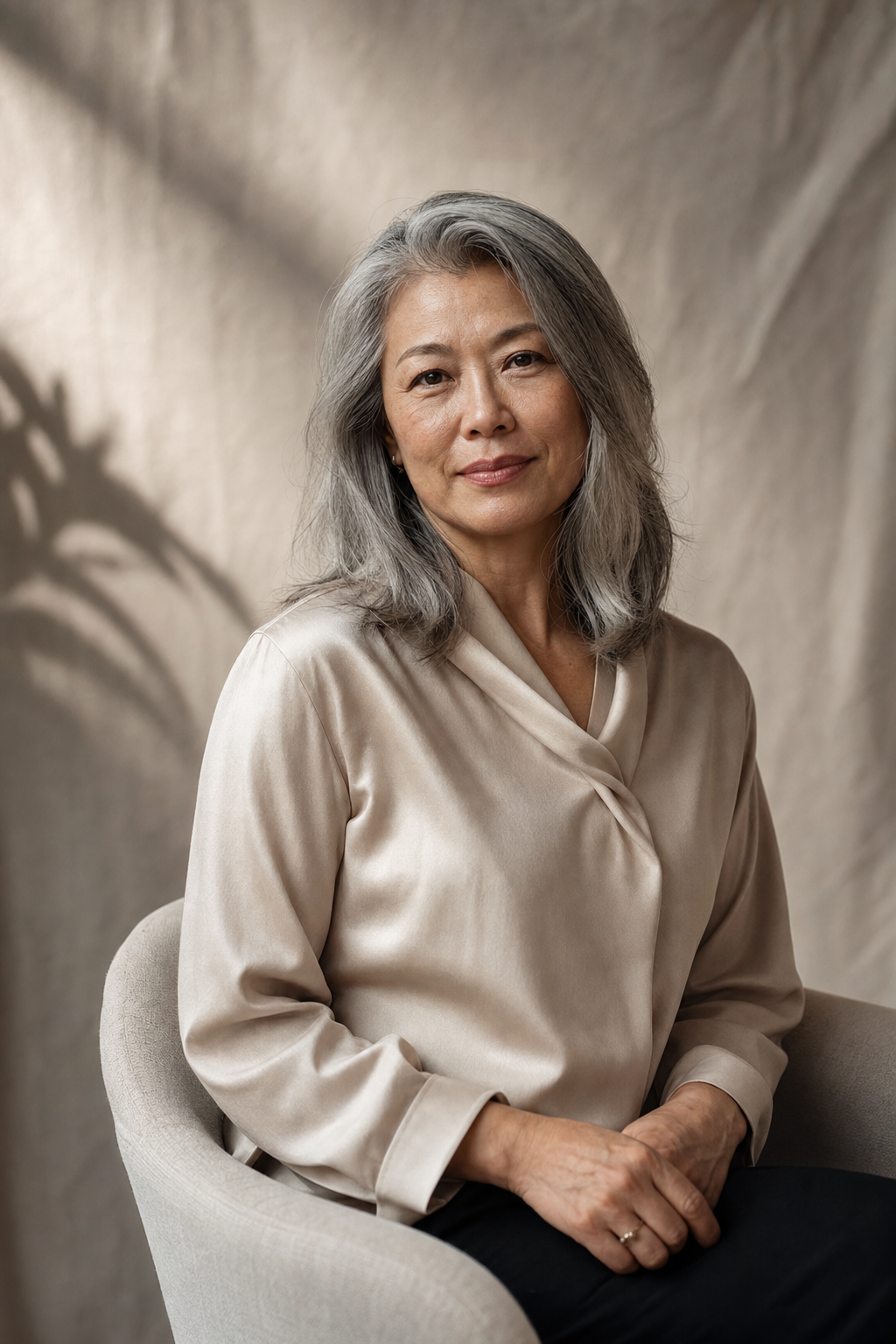
{SETTING} = a serene studio with a cream linen backdrop softly lit, a single architectural plant just out of frame casting a faint shadow on the backdrop. {ATTIRE_STYLE} = an oatmeal silk blouse with a soft draped collar. The prompt does NOT erase age. Visible pores, fine micro-texture, age-appropriate lines. That’s the rule the prompt holds, and it’s why this version of the portrait reads as warmth instead of “AI tried to make me twenty-eight.”
The Gen-Z indie creator
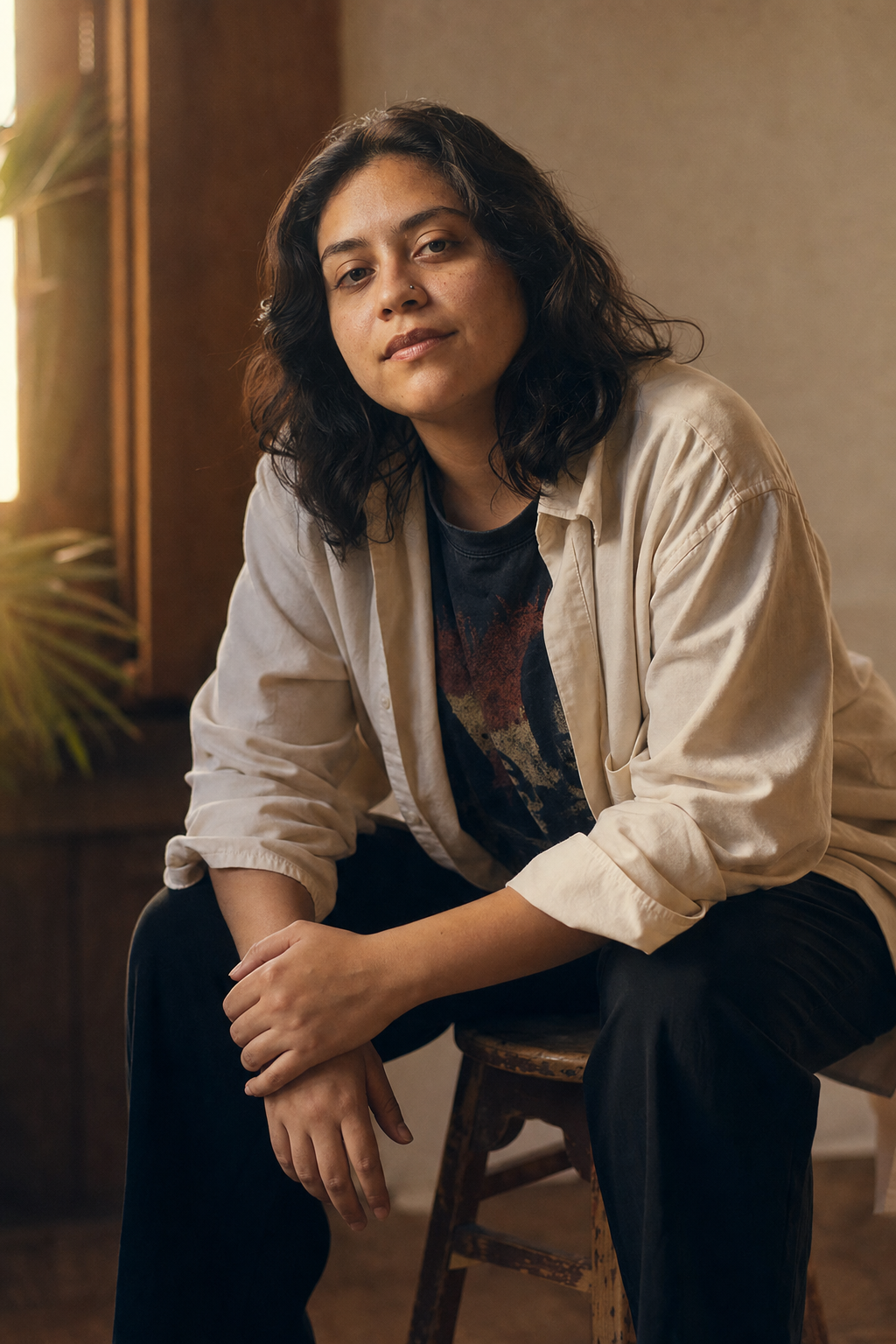
{SETTING} = a warm wooden interior bathed in golden-hour light through a window just out of frame, a soft cream wall behind, a simple worn wooden stool. {ATTIRE_STYLE} = a vintage band tee under an open oversized cream cotton oxford, sleeves slightly rolled. The same prompt, the same identity-lock, applied to a register that has nothing to do with “founder in a suit.” The frame still occupies 50–70% with the subject. The directional key still lands at upper-left at forty-five degrees. The skin still reads as skin.
Same prompt. Two placeholders. Five different careers, and zero studio days.
One paste-ready AI move a week. The kind you can use on a Tuesday or a Sunday. Subscribe to the newsletter.
AI Service vs. Studio Day vs. This Prompt
Here’s the honest math on the three roads to the same About-page portrait.
| AI Headshot Service ($39–99/mo) | Photographer Studio Day ($1,200) | This Prompt ($19 one-time) | |
|---|---|---|---|
| Cost | $39–99 per month | $1,200 per session, editorial floor | $19 one-time, paid once |
| Time to first usable image | 30–90 minute queue | 1 week (book + shoot + cull) | 2–4 minutes per render |
| Identity fidelity | Drifts. The face is “almost you,” a stranger wearing your face | Anchored. The photographer keeps you in the room | Identity-locked to your uploaded reference, every render |
| Skin realism | Porcelain default. Pores erased | Real skin, real pores | Pores + micro-asymmetry enforced in the prompt itself |
| Wardrobe flexibility | 5–10 preset styles | Whatever you bring to the studio | Open {ATTIRE_STYLE} slot: anything you write |
| Commercial-use license | Tier-gated, often unclear | Yours | Yours (you generated it, on your tool, with your prompt) |
The prompt isn’t pretending to be the studio. It’s doing the four things the studio’s $1,200 was buying you, in two minutes, minus the human director who tells you to lower your chin. For that trade, you pay nineteen dollars instead of twelve hundred, and you keep the commercial-use license. If you want this prompt plus the rest of the career-portrait sub already pre-baked with the same identity-lock and skin-realism rules, the Image Prompt Pack is $19.
Key Takeaways
- The reason every AI headshot looks fake isn’t the tool. It’s the five failure modes baked into the default prompt: Style-Mix beauty filter, identity drift, generic stock lighting, too-perfect symmetry, and mood-board wardrobe. All five are fixable in a single paste.
- Identity-lock comes first, not last. The very first instruction in any portrait prompt should name the face: bone structure, eyes, nose, lips, proportions, skin tone. Style and platform come after.
- A $1,200 editorial studio day is paying for four specific variables, not for talent: 85mm at f/1.4, directional cinematic key with cool fill, a real room, and a human director. Three of the four copy into a prompt.
- The same prompt re-skins across five different founder careers (solo consultant, indie SaaS founder, creative director, executive coach, Gen-Z creator) by swapping two placeholders. The identity-lock holds across all five.
FAQ
Q: Why does my AI headshot look fake?
A: Because the default prompt running under most AI-headshot services tells the model to give you “a professional headshot,” and the model fills in the rest from the most boring center of its training data. The result has five tells: porcelain skin with the pores erased, eyes pointing at the camera but not looking out of it, generic flat front lighting, over-symmetric features, and a generic preset wardrobe in a generic preset room. The fix is to write a prompt that names all five tells and forbids them by name: identity-lock first, skin texture forced back, directional lighting specified, one human figure only.
Q: How do I make an AI headshot of myself that doesn’t look like wax?
A: Upload one clear front-facing photo of yourself, paste a prompt block that does four things: (1) front-loads identity-lock to the bone structure, eyes, nose, lips, proportions, and skin tone from your uploaded reference; (2) requires visible pores, fine micro-texture, and natural micro-asymmetry and forbids porcelain smoothing by name; (3) names the lighting as directional cinematic key from the upper-left at forty-five degrees with a cool fill on the shadow side; (4) forces 50–70% frame occupancy on the subject and bans multi-exposure ghosts. The full version of this prompt is in the section above. Two placeholders (your setting and your wardrobe) are yours to swap; the rest is the prompt doing the work.
Q: What’s the best prompt for a realistic AI headshot of a founder?
A: A 2:3 vertical cinematic editorial portrait prompt that identity-locks to a reference photo you upload, names the lens (85mm at f/1.4), names the lighting (directional key from upper-left at forty-five degrees with a gentle cool fill), forces 50–70% frame occupancy on the subject, requires visible skin pores and micro-asymmetry, and bans multi-exposure ghosts and porcelain smoothing by name. The full text of the one we ship is in the section above. The same prompt re-skins across five different career registers (solo consultant, indie SaaS founder, creative director, executive coach, Gen-Z creator) by swapping two placeholders.
Q: AI headshot vs. real photographer, which one should I use for my About page?
A: If you have $1,200 and a week, and the chin-tilt feedback of a real human director is non-negotiable, book the studio day. If you have $19 and ten minutes, paste the prompt above and regenerate until the face reads like you. The honest gap is that the prompt does not have a director who tells you to lower your chin. Everything else the studio day was buying (the 85mm at f/1.4, the directional cinematic light, the real room, the editorial composition) is in the prompt by name. The commercial-use license is yours either way.
The next prospect doesn’t bounce
The consultant from the top of this piece eventually pasted the prompt block above into ChatGPT with one swap (warm-grey backdrop, charcoal blazer over cream silk). She generated four versions, picked the third, dropped it on her About page on a Wednesday morning. The prospect from Sunday night didn’t come back. A different one did.
The wax-figure portrait is the easiest deal you’ll ever lose. The fixed one is the cheapest you’ll ever close. The whole pack of career-portrait prompts, same identity-lock rules, four other portrait jobs (book launch, editorial cover, podcast/About page with doodles, cozy-cottage laptop founder), lives in the Image Prompt Pack for $19.