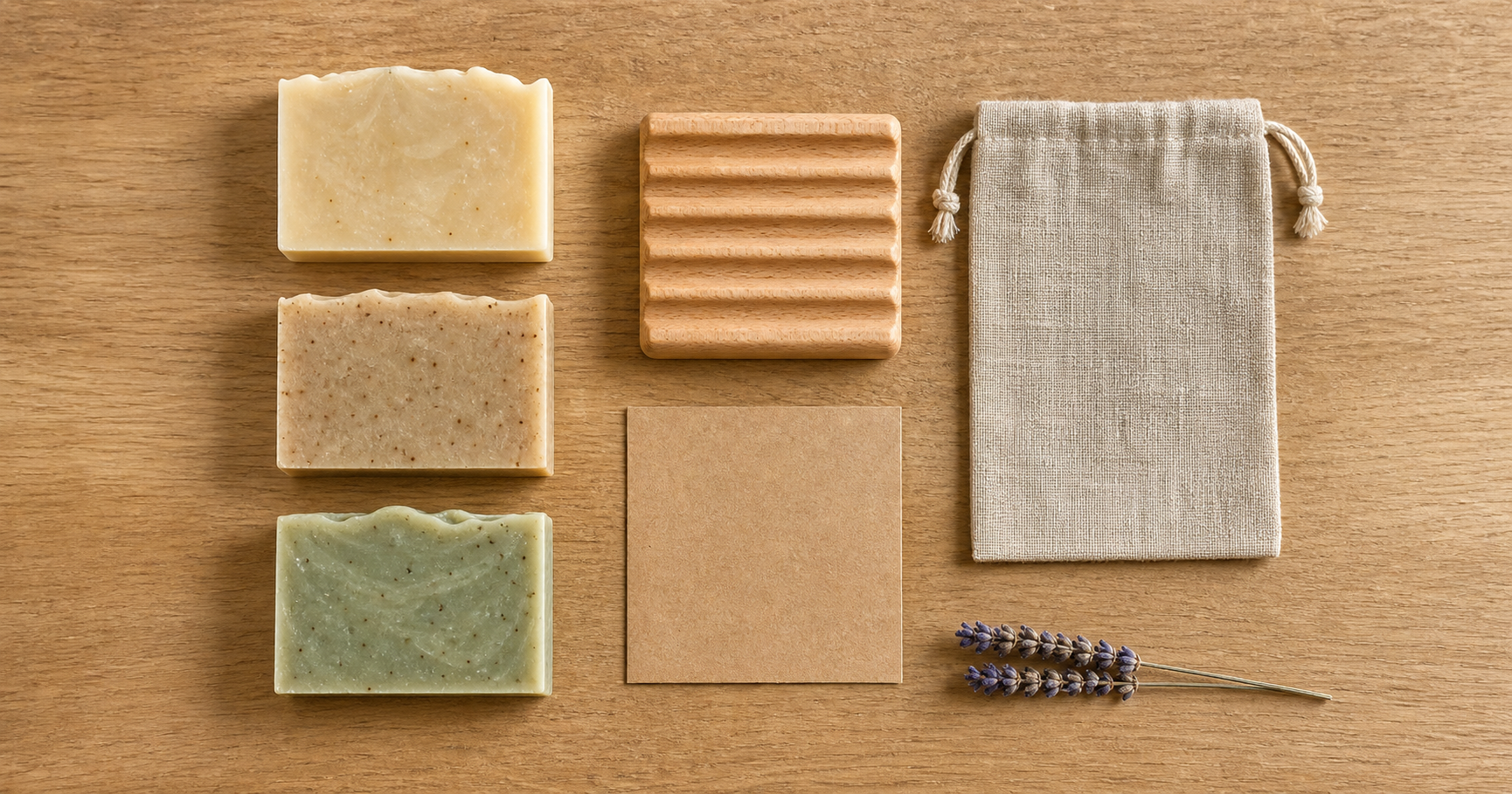
You don’t have a description problem. You don’t have a pricing problem. You have a slot-4 problem. The fourth photo on an Etsy listing, the top-down “here’s exactly what you get” flat-lay, is the one that closes the sale, and most makers don’t know it exists. A single free AI prompt rebuilds that photo in 10 minutes, with the items you actually ship, on a surface that actually looks like your brand. The product shoot it replaces runs $400-800 a half-day, per Shopify’s 2026 photography pricing guide. You’re going to do it for free.
”200 Favorites, 3 Sales”: Your Etsy Listing Isn’t Broken. Your Main Photo Is.
Picture an Etsy soap maker. Call her Maya. Eight months in. Forty-seven listings. Two hundred and three favorites. Three sales, total.
The listings work. The descriptions are fine. The price is fine. Her cold-process soap is, by every measure that matters in handmade-bath, a real product made by a real person. What’s broken is the main photo. Three bars of soap on a beige bedspread. Shot under a kitchen light. At 9 p.m. on a Tuesday.
She blames her copy. She blames her tags. She blames Etsy’s algorithm. None of those is the problem. The problem is that a favorite means “I might want this someday” and a sale means “I trust this enough to type my card number.” The photo in slot 4, the “what’s included” flat-lay, is where trust gets earned or lost. Until that photo says here is exactly what arrives at your door, the favorites pile up and the cart stays empty.
She also blames her budget. The good Etsy product photographer wants $400 for a half-day. She’s been making $42 a month. That math has only one answer, and it’s been “not this month” for eight months.
That’s the right diagnosis on the wrong fix. The $400 was buying composition, lighting, and on-brand styling. All three are now things you can paste.
What Etsy’s 10 Photo Slots Are Actually For (And Why Slot 4 Closes the Sale)
Every Etsy listing gets 10 photo slots. Etsy’s seller education talks about them as a sequence. The buyer scrolls left-to-right, and each photo answers one quiet question in her head before she’ll commit. Most sellers fill the first three and let the rest go to mood shots or repeats. That’s the conversion bleed.
Here’s the question each slot is silently answering. Per Etsy’s own seller handbook, stylized listing photos can lift click-through several-fold over the phone-on-bedspread baseline. Directionally meaningful, even if the exact number is shop-specific.
Of those ten silent questions, only slot 4 directly answers “what do I actually get?” The other nine circle it. That’s why favorites without sales is almost always a slot-4 problem. Maya was shipping a hero, a scale shot, and a packaging shot. She had no slot 4 at all.
What a $400 Product Shoot Actually Buys You (And Why You Don’t Need It Anymore)
A handmade-Etsy product shoot is priced in three honest bands, per Shopify’s 2026 product photography pricing guide: roughly $50-200 per image, $400-800 for a half-day, and $800-2,000 for a full-day. A small shop with a slot-4 problem doesn’t need a full day. She needs one good flat-lay. Mid-band, that’s $400. Add a rush fee around $40 if she wants it back in a week. Now it’s $260 for a single image done fast. And even then, the listing photo she paid for usually isn’t taken by the photographer she hired, since most boutique shops route through a small team.
So what is the $400 actually buying?
Three things, all named:
- Composition. Knolling discipline. Every item laid flat. Even spacing. Zero overlap. Horizontals stay horizontal. Verticals stay vertical. Generous breathing room. The reason a top-1% Etsy listing reads as “inventory honest, not styled scatter.”
- Lighting. Soft diffused daylight from above-left. Gentle natural shadows angling toward the lower-right of each item. Edge-to-edge crisp focus. Not the harsh kitchen overhead Maya was shooting under at 9 p.m.
- On-brand styling. The surface (warm oak, pale travertine, cream paper, patina-blue) that signals which shop this is, and the prop discipline (no decorative scatter, no confetti, no foliage filler; just the items, plus at most one small natural accent).
The $30,000 question Maya is actually asking, by the way, isn’t should I spend $400 on this photo? It’s should I treat this Etsy shop like a business or a hobby? The $400 is a $400 question sitting on top of a $30,000 question. We’re going to answer the small one with a free paste so she can spend her real attention on the big one.
Composition, lighting, styling. All three are now baked into one prompt. None of them require a photographer.
The Prompt: Paste, Get the Slot-4 Photo in 10 Minutes
This is the actual deliverable. One paste-ready block. Two open placeholders. Everything else locked.
Upload one clear photo of every item that goes in the order first, then paste the block below into ChatGPT (or Claude, Gemini, or any AI image tool), and swap the {ITEMS_LIST} and {SURFACE} lines for your own bundle.
Show the full slot-4 prompt block — paste-ready, click to expand
Generate this image:

Generate one ultra-realistic top-down 90-degree overhead flat-lay product photograph showing every item the buyer receives in the order laid out in precise knolling composition on a {SURFACE} background, 1:1 square aspect ratio, single image only. The items to include are {ITEMS_LIST}, each item placed flat on the surface with exact even spacing between every piece, perfectly straight horizontal and vertical alignment, balanced grid or balanced radial layout, zero overlap, every item fully visible with its full silhouette in frame, generous breathing room around each piece. Soft diffused daylight from above-left, gentle natural shadows, true-to-life color, warm welcoming "what's in the box" Etsy listing aesthetic, edge-to-edge crisp focus, authentic natural material rendering for handmade goods (real linen weave, real wood grain, real ceramic glaze, real soap texture, real paper fibre), no unrelated props, no decorative scatter, no confetti, no foliage filler, no labels or text annotations overlaid on the items, no logos, no watermark. The composition reads instantly as "here is exactly what you receive when you place this order" — clean, honest, inventory-style top-down flat-lay, 1:1 square aspect ratio.

Rules the AI must follow:
- Aspect ratio 1:1 square — strict, locked at start and end
- Camera angle is exactly 90 degrees straight overhead, no tilt, no perspective distortion — items must look flat to the surface, not angled
- Every item listed must be present, fully visible, not cropped, not overlapping another item
- Item spacing is even and deliberate — knolling discipline, not casual scatter; horizontals stay horizontal and verticals stay vertical
- No Lorem Ipsum, no garbled text, no labels, no captions, no watermarks anywhere on the image
- Realistic material texture required — visible weave, grain, glaze, fibre, surface imperfection; no AI plastic flat digital look, no over-smoothed surfaces
- Single image output — one 1:1 flat-lay, no contact sheet, no variant grid, no before/after
- All incidental text in English Latin script if any appears (it shouldn't)
- Output the image directly without explaining the prompt back

Replace these placeholders with your details:
- ⚠️ REQUIRED — upload before pasting: clear photos of every item that goes in the bundle (one per item is enough — the AI uses these to render the actual products, not generic stand-ins)
- {ITEMS_LIST} = 3 bars of handmade soap, 1 small wooden soap dish, 1 natural linen drawstring bag, 1 kraft-paper thank-you card, 1 sprig of dried lavender
- {SURFACE} = warm natural oak wood tabletop (or pick one: soft cream linen / pale marble slab / matte off-white paper / textured beige stoneware / dark slate)
Here’s what each piece of that prompt is doing, in plain English:
- “Top-down 90-degree overhead flat-lay” locks the camera straight down. No tilt. No perspective distortion. This is the only angle that reads as “honest inventory” instead of “styled lifestyle.”
- “Precise knolling composition… exact even spacing… zero overlap” is the composition rule that costs $400 in human hours. Knolling is the visual language top-1% Etsy listings actually use. Even spacing, horizontals horizontal, verticals vertical, generous breathing room.
- “Soft diffused daylight from above-left, gentle natural shadows” is the lighting line. This is what you were buying when you hired the photographer. The model now does it for free.
- “Authentic natural material rendering (real linen weave, real wood grain, real ceramic glaze, real soap texture, real paper fibre)… no AI plastic flat digital look” is the texture override that keeps the photo from reading as rendered. AI defaults to over-smooth, which is exactly the failure mode that gets a buyer to scroll past your listing without ever clicking. This line forces the render back to handmade.
- ”⚠ REQUIRED upload before pasting: clear photos of every item that goes in the bundle” is the only part of this that takes you 5 minutes. One quick phone snap of each item, uploaded as a reference. The AI uses these to render the actual products, not generic stand-ins. Skip this step and the photo is generic. Don’t skip it.
The two open placeholders are where your shop enters the image. {ITEMS_LIST} is everything that goes in the order (the soap, the dish, the bag, the card, the lavender) written as a plain comma list. {SURFACE} is your background: warm natural oak wood tabletop is the default; pale marble, cream linen, matte off-white paper, beige stoneware, or dark slate are the five surfaces that signal a coherent brand. Pick one and stay there. The same surface across every listing photo is half of what makes a shop read as a shop.
Paste it into ChatGPT, Claude, Gemini, or any AI image tool that takes uploads. Free tier works on all three. Regenerate three or four times if the first render isn’t right. There’s no rush fee for the next render.
Five Real Examples: Soap, Candle, Jewelry, Stationery, Print
One prompt. Two lines swapped. Five different makers. Same slot 4, re-shot for each.
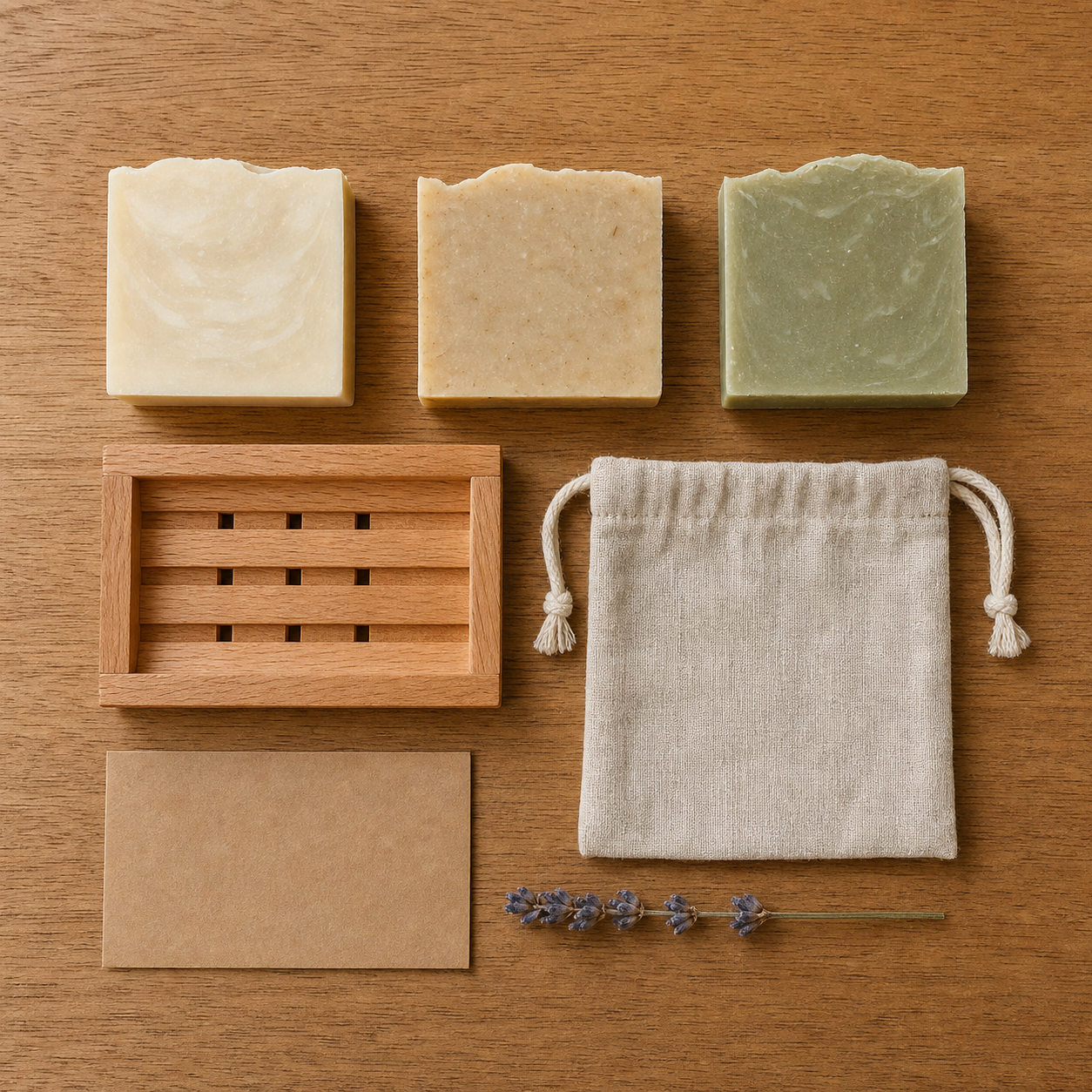
Soap maker, warm oak
{ITEMS_LIST} = 3 bars handmade soap, 1 small wooden soap dish, 1 natural linen drawstring bag, 1 kraft-paper thank-you card, 1 sprig of dried lavender. {SURFACE} = warm natural oak wood tabletop. What this silently tells the buyer: the bars are real, the dish is included, the bag is the gift wrap, the lavender is the maker’s signature. Nothing in this photo is decoration; every item is something she’s actually getting.
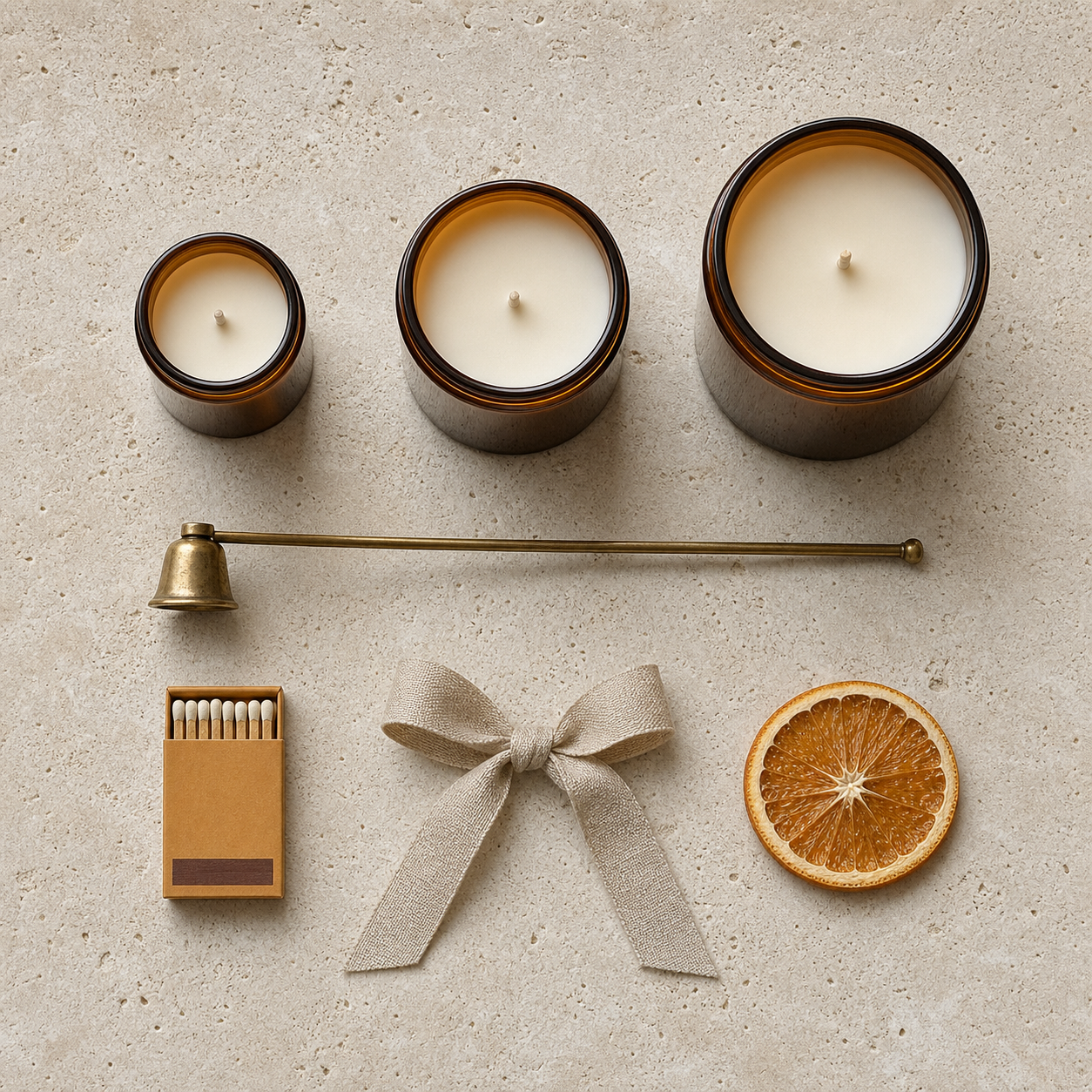
Candle maker, travertine slab
{ITEMS_LIST} = 3 candles in amber glass, brass snuffer, matchbook, linen ribbon tie, dried orange slice. {SURFACE} = pale travertine slab. What this silently tells the buyer: the candles come as a set of three, the snuffer is included, the brand has range. The travertine is the brand cue. Cooler, more apothecary than the soap maker’s warm oak.
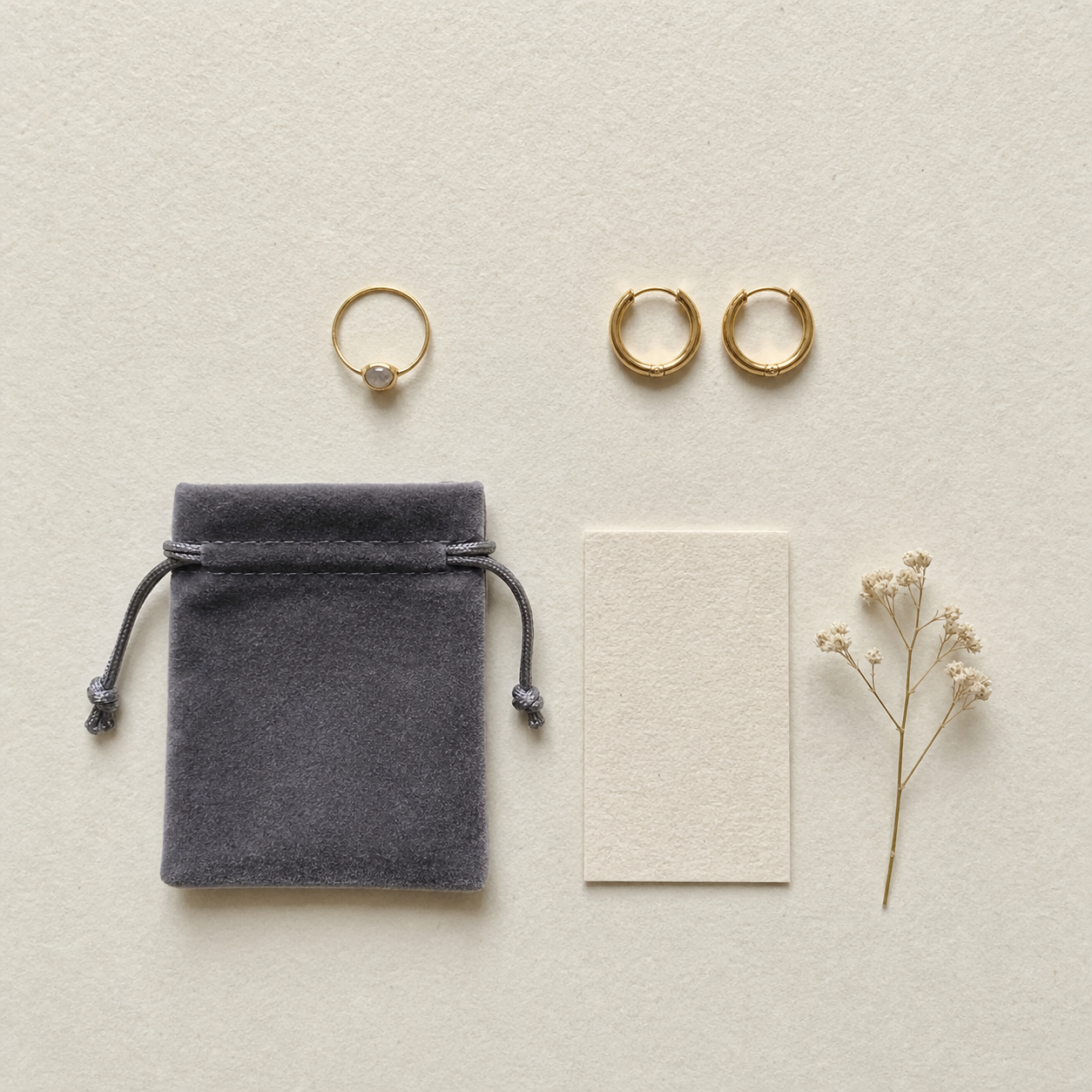
Jewelry maker, textured cream paper
{ITEMS_LIST} = 1 gold pendant ring, 1 pair gold hoop earrings, 1 small velvet pouch, 1 printed care card, 1 single dried botanical. {SURFACE} = textured cream art paper. What this silently tells the buyer: the pouch is the gift box, the care card means the maker actually cares whether it lasts, the dried sprig is restraint. Jewelry buyers read prop discipline as a quality signal. One botanical, not three.
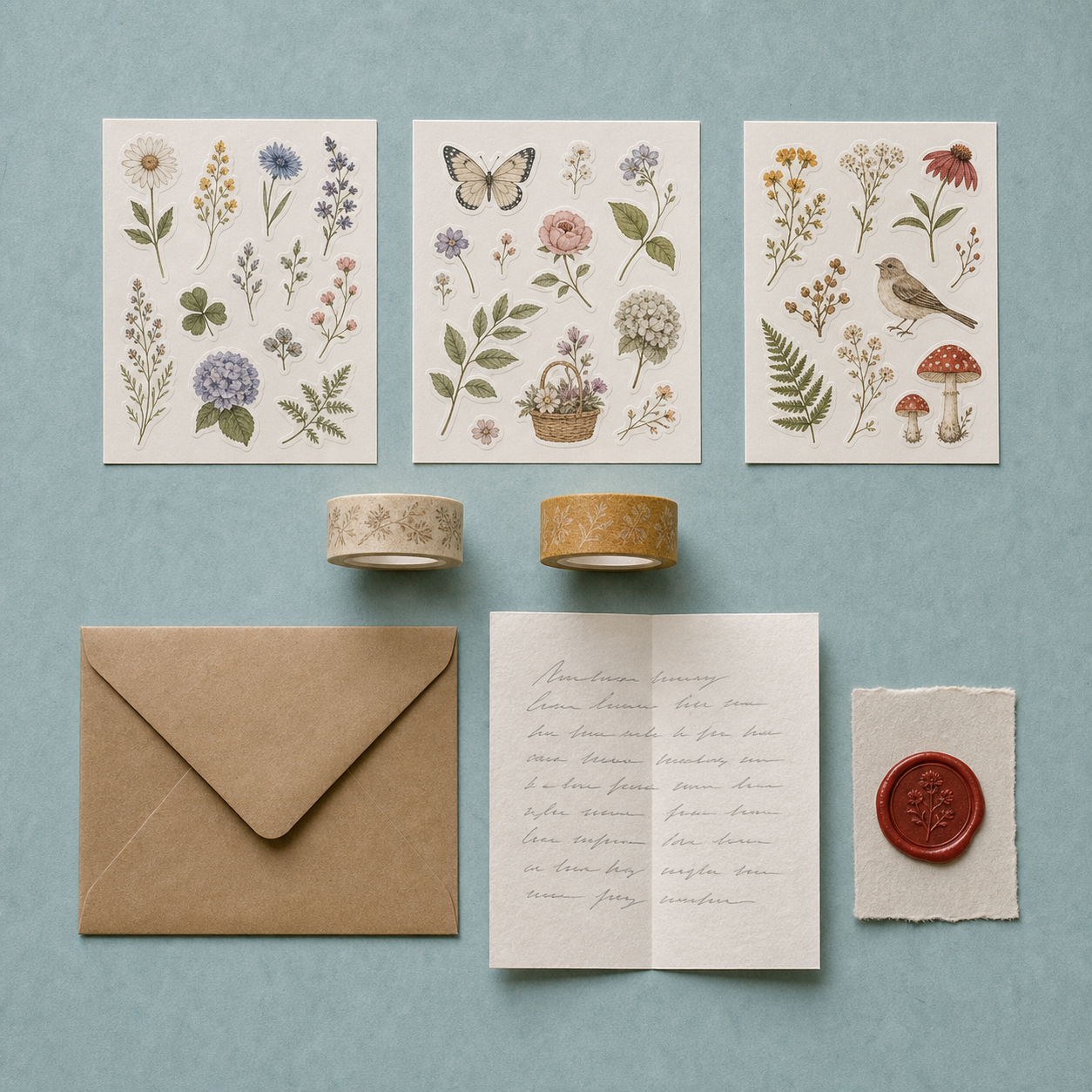
Stationery shop, patina-blue paper
{ITEMS_LIST} = 3 sticker sheets, 2 rolls of washi tape, 1 kraft envelope, 1 handwritten note, 1 small red wax seal. {SURFACE} = soft patina-blue paper backdrop. What this silently tells the buyer: the wax seal is the maker’s personal touch, the handwritten note is real, the order ships in a real envelope, not a poly mailer. The patina-blue paper rides Pinterest’s “Pen Pals” pen-and-paper aesthetic. Same prop, same era.
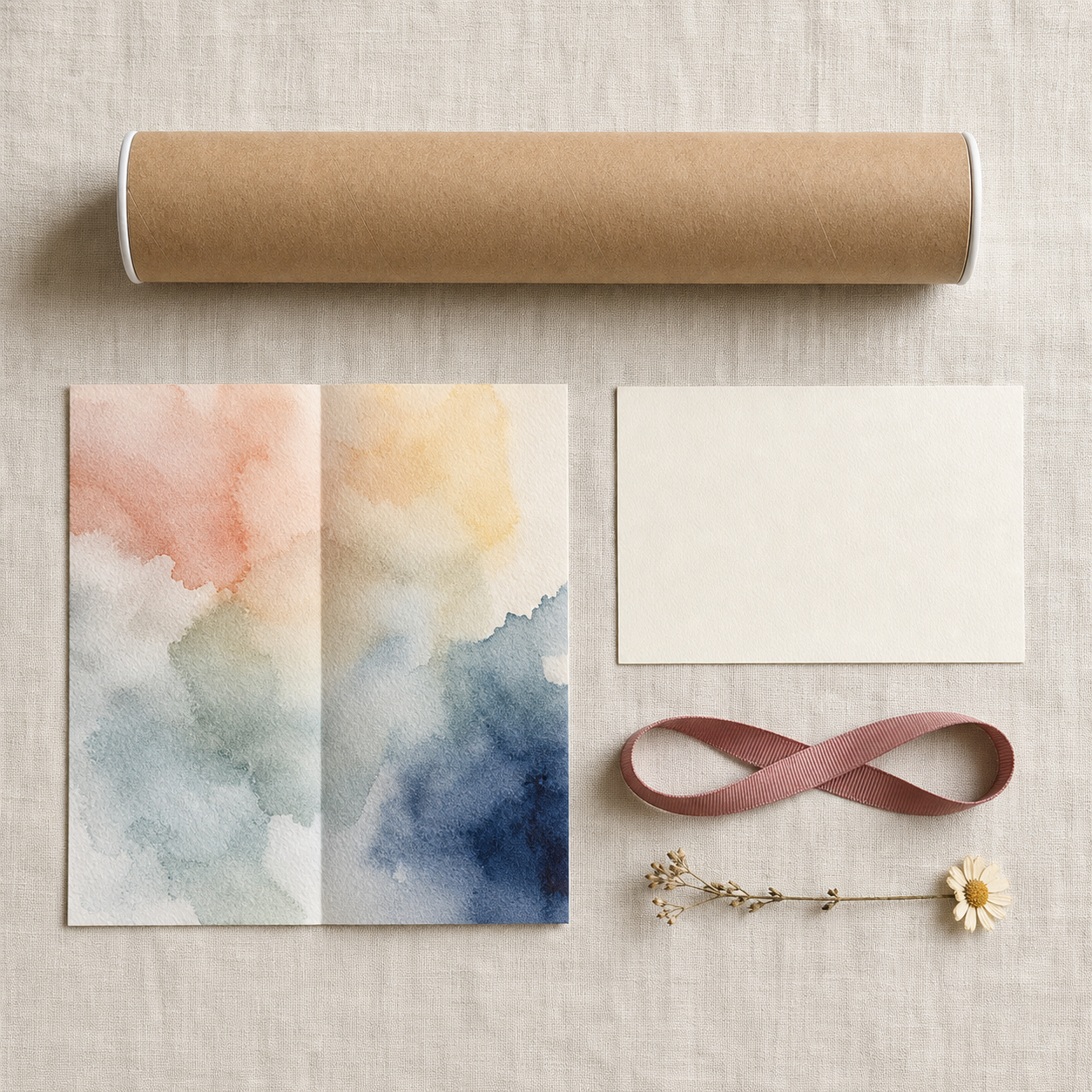
Print shop, washed cream linen
{ITEMS_LIST} = 1 folded art print, 1 cardboard mailing tube, 1 thank-you postcard, 1 branded grosgrain ribbon, 1 single dried wildflower. {SURFACE} = washed cream linen fabric. What this silently tells the buyer: the print ships rolled in a real tube, not folded into a flat envelope; the postcard is hand-signed; the ribbon ties the package together. For print shops, the mailing tube is the trust-converter. Buyers have been burned by flat-shipped prints before.
Five makers. Same paste. Two lines swapped. Slot 4 done.
One paste-ready AI move a week. The kind you can use on a Tuesday morning before the kids are up. Subscribe to the newsletter.
The Other 9 Photo Slots, and the Prompts for Each
The slot-4 fix is the single most important photo you can re-shoot this month, because it’s the trust-converter. But the other nine slots are still doing real work. Each silently answers one of those questions in the buyer’s head. Slot 1 gets her to click in the first place. Slot 2 proves the object exists outside the photo studio. Slot 3 answers “how big is it really?” Slot 5 proves the craft is real. The maker who has all ten slots working is shipping a top-1% Etsy listing.
The prompts for the other nine slots (hero, lifestyle in hand, scale shot, detail close-up, packaging) plus the four other listing-photo families (apparel and merch mockups, real estate and Airbnb listings, brand and packaging, beauty and skincare) all live in the Image Prompt Pack ($19, one-time, lifetime updates). One paste each. Same {ITEMS_LIST}-and-{SURFACE} shape across every slot. The pack is what turned the $400 product shoot into a question you only ask once.
What This Saves You, In One Table
Phone photo, AI flat-lay, $400 studio shoot, $260 rush — same job, four price points. Here’s how they stack up across cost, time, brand consistency, and iteration.
| Phone photo on a bedspread | AI flat-lay (this prompt) | $400 product shoot | $260 rush shoot | |
|---|---|---|---|---|
| Cost | $0 | $0 (free AI tool) or about $20/month for a paid tier | $400-800 half-day, per Shopify 2026 pricing | $260 ($220 mid-band hand-styled image + ~$40 rush fee) |
| Time | 5 minutes | 10 minutes paste + regenerate | 5-10 days including scheduling | 2-3 days |
| On-brand consistency | Low — depends on your room, your light, your day | High — same surface, same light, same composition every render | High — but only for items the photographer styled in the session | High |
| Pinterest pin-ability | Low | High — 1:1 square top-down is native Pinterest format | High | High |
| Item fidelity | Perfect (it’s the real thing) | High — uses your uploaded item photos as the visual source | Perfect | Perfect |
| Iterations until the photo reads right | One (it’s the photo you took) | Unlimited regenerations | Zero — first send is what ships | Zero |
| Cost per re-shoot when an item changes | $0 (re-shoot yourself) | $0 (swap the {ITEMS_LIST} line, re-paste) | $400-800 again | $260 again |
FAQ
Q: Will Etsy ban my listing for using AI-generated photos?
A: No. Etsy’s policy on AI-assisted listing photos permits them when the product is real and the photo represents what actually ships. That’s the same standard a stylized phone-photo has to meet. If your buyer opens the box and the items match the flat-lay, you’re inside policy. The prompt above is built specifically to render the items you upload. It’s an inventory representation, not a fabrication.
Q: Do I need a paid AI tool to run this prompt?
A: No. ChatGPT free tier, Google’s Gemini, and Anthropic’s Claude all generate this image from the same paste, with one upload per item. Free tier limits the number of images per day, not the quality of each render. If you’re re-shooting one slot 4, you’ll fit inside any free-tier budget.
Q: What photos do I upload as the source, every angle of every item?
A: One clear, well-lit photo per item is enough. The AI uses these as the visual reference for what the item actually looks like, so render fidelity goes up the better your reference photos are. Phone snap on a kitchen counter, daylight if you can swing it, sharp focus. You’re not shooting the listing photo here. You’re giving the AI ground truth so the listing photo renders your actual products, not generic ones.
Q: What if my product is one item, not a five-piece bundle?
A: Slot 4 isn’t for one-item shops. That’s what slots 1 (hero) and 3 (scale) cover. If you only ship one object, skip slot 4 and double down on slots 1, 3, and 5 (detail close-up). The slot-4 flat-lay starts paying off the moment your order includes the product plus packaging plus a card. Three items is the minimum threshold where “what’s included” stops being obvious and starts needing a photo.
Key Takeaways
- Favorites without sales is almost always a slot-4 problem. The other nine photos earned the click; the missing flat-lay lost the sale.
- The $400 product shoot was buying composition (knolling discipline), lighting (soft diffused daylight from above-left), and on-brand styling (the surface). All three are now baked into one paste-ready prompt.
- The slot-4 prompt has two open lines,
{ITEMS_LIST}and{SURFACE}. Everything else is locked. Five surfaces (oak, travertine, cream paper, patina-blue, washed linen) signal five different brands. Pick one and stay there across every listing. - Five categories tested (soap, candle, jewelry, stationery, print) and each re-shoots from the same paste with two lines swapped. Free AI tool, 10 minutes, unlimited regenerations.
- The other 9 photo slots are still doing real work. The Image Prompt Pack covers all 10 listing slots plus four other listing-photo families a real Etsy shop will eventually need.
The Slot-4 Photo Is the Cheapest Way to Vote “Business”
The favorites-to-sales gap doesn’t close itself.
Maya isn’t behind because she’s not a photographer. She’s behind because nobody told her slot 4 existed. Now she knows. By Sunday afternoon (assuming she takes a few phone snaps of her soap, her dish, her bag, her card, and her lavender; pastes the block above into ChatGPT; runs it twice) the slot-4 photo is sitting on her main listing. Same items. Same shop. Different photo. Same $42-a-month soap, finally shown the way a real shop shows it.
The $400 question (do I hire a photographer?) just got answered with a free paste. The $30,000 question (do I treat this shop like a business?) is the one that’s still on her desk. The photo on the listing is the cheapest way to vote yes.